30-minute dinner
Sheet-Pan Beef Fajitas
Thin strips of beef, peppers, and onions roast quickly for colorful weeknight fajitas.
Published · Updated
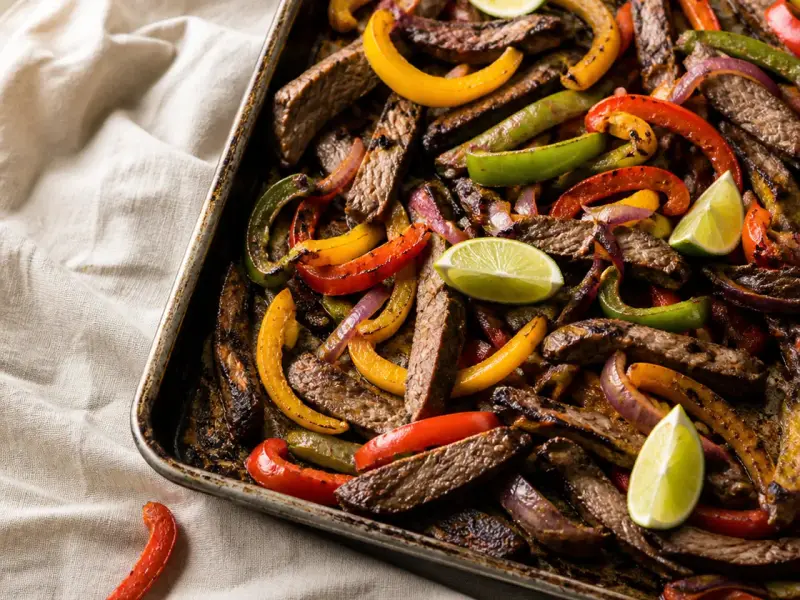
- Total time
- 30 min
- Serves
- 6
- Est. protein
- 29g
The recipe
Sheet-Pan Beef Fajitas
Ingredients
- 1 1/2 pounds flank steak, thinly sliced against the grain
- 3 bell peppers, sliced
- 1 large red onion, sliced
- 2 tablespoons olive oil
- 2 teaspoons chili powder
- 1 teaspoon ground cumin
- 1 teaspoon garlic powder
- 1 teaspoon kosher salt
- 12 small corn tortillas
- 1 lime, cut into wedges
Instructions
- Heat the oven to 450°F. Place a rimmed sheet pan in the oven while it heats.
- Toss the beef, peppers, and onion with olive oil, chili powder, cumin, garlic powder, and salt.
- Carefully spread the mixture over the hot pan. Roast for 10–12 minutes, stirring once, until the beef reaches 145°F and the vegetables are crisp-tender.
- Serve in warm tortillas with lime wedges.
Food safety: Cook whole-cut beef to at least 145°F and rest for 3 minutes; avoid cross-contamination.
Leftovers: Refrigerate in a covered container for up to 3–4 days. Reheat hot components to 165°F before serving.
The preheated pan is the recipe
Fajitas are a griddle dish. The restaurant version arrives sizzling because the beef and peppers hit metal that is already screaming hot, which browns the outside before the inside has time to release its water. A domestic oven cannot reproduce a flat-top, but it can get close if you use the one trick this recipe insists on: put the empty sheet pan in the oven while it preheats to 450°F, and add the food to a pan that is already hot.
The difference is not subtle. On a cold pan, the beef and vegetables warm up slowly, sweat, and end up braising in their own juices — grey meat, limp peppers, a puddle. On a preheated pan you get an audible sizzle on contact, browned edges within a couple of minutes, and vegetables that keep some bite after 10 to 12 minutes.
Handle that pan with respect. Pull the rack out, spread the mixture quickly with tongs, and push it back in. A crowded, carefully arranged pan defeats the purpose, because every second the oven door is open costs you heat.
Slicing flank steak
Flank is a lean, coarse-grained cut. Sliced thinly across the grain it is tender and beefy; sliced with the grain it is a chew toy. Find the direction the long muscle fibers run — on flank they are obvious — and cut perpendicular to them at about 1/4 inch.
Two things make this easier. First, firm the steak in the freezer for 15 to 20 minutes, which makes thin slices possible without a razor-sharp knife. Second, slice on a slight bias, which widens each piece and shortens the fibers further.
Whole-cut beef is safe at 145°F with a three-minute rest, but at 1/4-inch thickness the strips will pass that quickly. At that thickness carryover is negligible, so go by the thermometer rather than by the pan: 145°F in the thickest strips, edges browned, centers still pink.
Ingredient notes
Bell peppers. Three peppers in different colors is partly aesthetic, but red and orange peppers are also sweeter than green, which matters against the chili powder. Slice them about the same width as the beef so everything roasts at one rate.
Chili powder and cumin. American chili powder is a blend, already containing cumin, garlic and oregano; the extra cumin here pushes it toward the earthier, more Tex-Mex end. If you have chipotle powder, a quarter teaspoon adds smoke that mimics a griddle.
Corn tortillas. Warm them properly — 20 seconds per side in a dry skillet, or a stack wrapped in a damp towel and microwaved for 45 seconds. A cold tortilla cracks and tastes of raw masa. Flour tortillas work and are more forgiving, if less traditional.
Lime. Non-negotiable, and it goes on after cooking. Roasting flattens acidity; the squeeze at the table is what makes the dish taste bright rather than dusty.
What goes wrong
- Overloading the pan. This quantity fills a half-sheet. If the strips overlap, they steam. Two pans, both preheated, if you are doubling.
- Slicing before cooking and then again after. Slice once, before. Cutting cooked strips releases juice you wanted in the meat.
- Cooking to well-done. Flank has very little intramuscular fat, so there is nothing to keep it moist past medium. Ten to twelve minutes at 450°F is the window, and the pan should come out at 145°F in the thickest strips, while their centers are still pink.
Toppings and what to serve
Keep the pan itself simple and put the complexity in the bowls on the table: charred salsa, pickled red onion, sliced avocado or guacamole, cilantro, crumbled cotija, sour cream or Greek yogurt. Pickled onion in particular does a lot of work here, since its acidity plays the same role as the lime.
Black beans and rice round it out into a larger meal. For drinks, a lager or a lime-heavy margarita; both are cold and acidic, which is what this wants.
Make-ahead and leftovers
The spice mixture can be pre-mixed in bulk and kept in a jar. The beef and vegetables can be sliced and tossed with oil and spices up to a day ahead and refrigerated in a covered bowl — in effect a short dry marinade that improves the seasoning penetration. Do not add lime before cooking, or the acid will start to firm the surface of the meat.
Leftovers keep three to four days. Reheat in a hot skillet rather than a microwave to avoid a rubbery texture, and reheat only what you will eat, since repeatedly heating thin beef strips is unkind to them. Leftover fajita filling is excellent in quesadillas, folded into scrambled eggs, or piled on nachos.
Questions people ask
Can I use skirt steak? Yes, and many would argue it is the more traditional choice. It is slightly fattier and cooks even faster, so check at 8 minutes.
What about chicken? Slice boneless thighs or breast to the same thickness and cook to 165°F, which takes roughly the same time at this temperature.
Do I need to marinate? Not for a weeknight. The oil-and-spice toss seasons the surface, which is where most of the flavor lands on thin strips anyway.
Why corn tortillas over flour? Personal preference. Corn adds its own toasted flavor and is naturally gluten free; flour is softer and less prone to tearing under a heavy load.
About the protein estimate29g per serving is an estimate based on standard ingredient data. Brands, substitutions, and portion sizes change the result. View the source.
More dinners like this
Cajun Chicken Corn Skillet
Cajun-spiced chicken, corn, peppers, and black beans cook together in a colorful 30-minute skillet.
Get the recipe
Ginger Beef Ramen Stir-Fry
Lean beef, broccoli slaw, and ramen noodles cook in a gingery soy sauce in 25 minutes.
Get the recipe
Mediterranean Tuna Stuffed Potatoes
Fluffy baked potatoes get filled with tuna, chickpeas, tomatoes, olives, and lemon yogurt.
Get the recipe